
What are the options for treating PAH?
People living with pulmonary arterial hypertension (PAH) have more reasons for hope than ever before. PAH treatment options continue to advance, and ongoing research has helped specialists understand how to manage your unique PAH.
Learning more about the types of PAH treatments available and partnering with your healthcare team may help you stay active and feel better.

"I didn’t settle for good enough because I wanted better. I wanted a better quality of life for myself. PAH will not control my life. I will." —Laura, PAH Initiative Patient Ambassador
What are the differences between the types of PAH treatments?
Two important ways treatments are different include:
- How you take them (“form”)
- How they work in your body (“pathway”)
PAH treatments can be taken in several ways, including oral (pill), inhaled, infused (pump therapy), and injected forms. Some patients may prefer one form (also called formulations or routes of administration) compared with others. Each form has its own pros and cons. Your PAH specialist can help you understand these differences and determine which form might be best for you.
Forms of PAH treatments
Oral (pill)

Method of delivery
Delivers the medication through the stomach and intestines, where it is absorbed into the bloodstream
Considerations to discuss with your doctor
- Delivers medication in a less targeted way, which may lead to side effects
- For oral medications with different dose strengths available, the amount of medication may be gradually adjusted (“titrated”) to be more effective and/or manage side effects
- Taken 1-3 times per day, depending on the product
Inhaled
Method of delivery
Delivers the medication by breathing it into the airways of the lungs
Considerations to discuss with your doctor
- Can be taken via a small inhaler or nebulizer device
- Dose can often be adjusted (titrated) quickly
- May start working rapidly
- Taken 4 or more times per day, depending on the formulation and device
Infused (pump therapy)

Method of delivery
Delivers the medication directly into the bloodstream or muscle tissues
Considerations to discuss with your doctor
- Uses a pump that delivers the medication continuously—either intravenously (directly into vein) or subcutaneously (under the skin)
- Can often be adjusted (titrated) very quickly to reach the right dose
- Preparation may require mixing to obtain the right dose as prescribed by your doctor
Injected

Method of delivery
The medication is absorbed into the bloodstream after it is injected under the skin
Considerations to discuss with your doctor
- Dose is typically increased, according to how well it works and is tolerated
- Preparation requires mixing to the right dose as prescribed by your doctor
- Taken less often than other forms
PAH treatments also help rebalance different pathways
Each medication helps fix 1 of several substance imbalances that may develop in PAH
Your body produces several natural substances essential to healthy blood vessels and lung function.
In people living with PAH, these substances become imbalanced—your body may produce too much of some and too little of others. One or more of these substance imbalances cause narrowing of lung blood vessels and thickening of vessel walls, leading to worsening PAH.
Each substance imbalance corresponds to what PAH experts call a treatment “pathway.” PAH treatments work on 1 of these different pathways to help fix a specific imbalance.
PAH treatments can help restore balance in 1 natural substance by either:
- Slowing down production when your body may be making too much of the substance, or
- Replacing or increasing production when your body is not making enough of the substance
The right treatment plan can help you get back into balance
Learn more about the substances that are out of balance in PAH and how medications can help fix these imbalances.
How PAH Medications WorkExplore the important role of prostacyclin-class medications in PAH treatment plans.
Prostacyclin-Class MedicationsStill having a “bumpy ride” with PAH symptoms?
How are substance imbalances with PAH like the tires on your car? Watch to learn more about the impact imbalances can have on your PAH symptoms.
Imagine you’re driving your car, and it becomes imbalanced and wobbly. Why? Because several of your tires have either too much or too little air pressure. Now your car isn’t functioning as it should, and your ride has become quite bumpy. What would you do? Would fixing only 1 or 2 of the tires be the best solution if more of the tires are affected? Of course not. So, we know a car will run more smoothly with balanced tires. In a similar way, your body needs the right amount of each of 4 natural substances to keep your lungs and blood vessels healthy. Normally, the body produces the right amount of these substances, but in people with pulmonary arterial hypertension, or PAH, an imbalance in 1 or more of the substances can affect blood vessels, causing the walls to thicken and narrow. This results in PAH symptoms and strain on the heart over time, as it struggles to push blood through the lungs. This is where PAH medication come in. Just like a mechanic adjusts the tires to restore your car for a smoother ride, medications may help balance the substances in your body to keep the blood vessels in your lungs healthy. Now, knowing which substances are imbalanced, and the extent of each imbalance, isn’t as easy as fixing a tire. In PAH, there’s no test to pinpoint imbalances, like a tire gauge shows when tires need air. It’s as if we can’t see the tires, but we can tell something is wrong because of the bumpy ride. Based on clinical trials, we do know that most people with PAH have at least 2 substances out of balance. That’s why experts recommend most patients take 2 or more medications to address these imbalances. Understanding the role of these substances in PAH, and the need to rebalance them, can empower you to have informed treatment discussions with your healthcare team. And just like driving a well-maintained car, navigating life with PAH may become smoother with the right balance and care. So, if your ride is still bumpier than you’d like, ask your PAH specialist if you can do more to get closer to balance.
Navigating your unique PAH
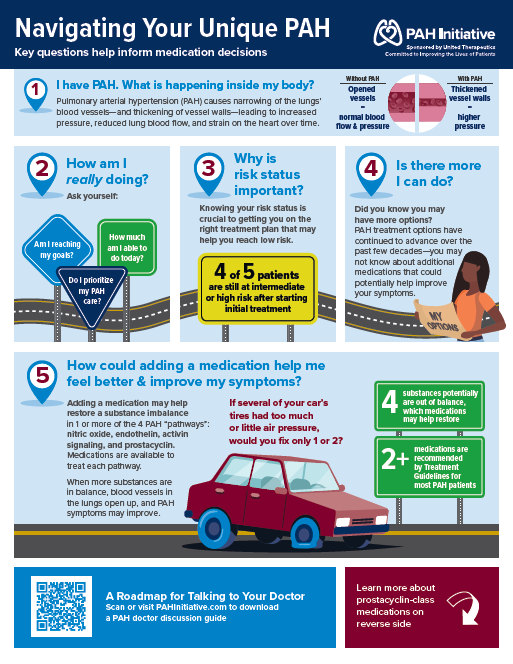
Understanding what is happening in your body and why you may still have symptoms can feel overwhelming.
Download and print this helpful infographic as you consider your goals and talk with your doctor about how to reach them.
Download Pathways Infographic