

Please consult with your physician or healthcare provider before starting an exercise routine. Do not start an exercise routine if your physician or healthcare provider advises against it. This article is offered for educational purposes only and is not a substitute for nor replaces professional medical advice, diagnosis, or treatment. If you act on information contained in this article you agree that you are doing so at your own risk. IN THE EVENT OF A MEDICAL EMERGENCY, PLEASE CALL EMERGENCY SERVICES IMMEDIATELY.
When living with pulmonary arterial hypertension (PAH), the thought of exercising can be intimidating. You might even be wondering: Can I exercise? Where would I even start? In the past, people with PAH were often advised against exercising because, during exercise, the heart has to work harder to pump blood to the body, especially the arms, legs, hands, and feet.
Today, researchers and doctors increasingly see the benefits of exercise for people with PAH when done safely and in close coordination with a healthcare team. In fact, along with PAH medications, exercise is now considered by many as an integral part of a comprehensive PAH treatment plan.
So, what are the benefits of incorporating exercise into your treatment plan? Let’s look at the evidence. Studies show that a 12-week exercise training program for people with PAH increased endurance and 6-minute walk distance, which is used to assess exercise capacity. Some of the other physical benefits shown in these studies include improved WHO Functional Class and lowered blood pressure.
Beyond the evidence for physical improvement, studies also show that an exercise program may improve quality of life for people living with PAH, including reduced depression and fatigue.
If you’re wondering how to get started or if an exercise program is right for you, talk to your healthcare team. Recommendations for exercise vary from patient to patient, so it’s important to work with a PAH specialist to develop a program that’s uniquely designed for you. If available, your doctor may recommend a cardiac or pulmonary rehabilitation center as part of your program.
Regardless of the setting, exercising under supervision is key. A specialist will be able to assess your needs and abilities while monitoring how exercise is impacting you.
Every exercise program will be different, but examples of programs studied in clinical trials of patients with PH include bicycle training, walking, dumbbell training, respiratory training, endurance training, treadmill walking for 30 to 45 minutes, aerobic interval training, step climbing, and resistance training. The regimens studied in clinical trials generally range from 10 to 15 weeks.
Remember: An exercise program that is right for some patients may not be right for others. Talk with your doctor about what is right for you.

Once you’ve worked with your healthcare team to develop the right plan for you, consider the following tips from the Pulmonary Hypertension Association (PHA) for exercising safely:
To learn more about exercise, visit the PHA website.
When it comes to vegetables, you can’t go wrong with leafy greens—and all of these various vegetables are packed with vitamins and nutrients:
Remember, you and your PAH are unique. So, it’s always best to talk to your healthcare provider about what dietary choices are best for you.
PAH is a complicated disease that can be difficult to understand. We’ve broken it down for you with easy-to-understand information, simple graphics, and informative videos from a PAH specialist.
What Is PAH?
Learn how Peggy renewed her competitive spirit after her PAH diagnosis and how she won’t let an oxygen tank define her.
Competitive Spirit with PAH ⟩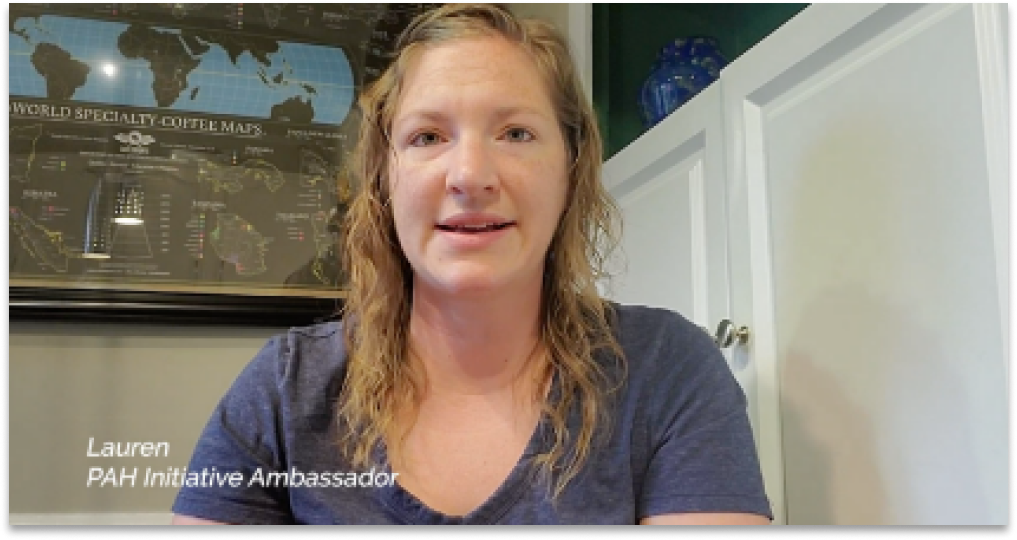
How has knowing their risk status helped Lauren and Karen better understand if their treatment plan is working?
Knowing your PAH Risk Status ⟩
Living with PAH can be a big adjustment and taking care of yourself can make a big difference. But where do you start?
Self-Care and Healthy Living ⟩