
Right heart health is key to PAH care
Although pulmonary arterial hypertension (PAH) is a lung disease, vascular remodeling in the pulmonary arteries directly impacts the right heart, leading to right-sided heart failure, the most common cause of death in PAH patients.1-3 This makes near-normalization of the right heart a critical treatment goal, reflecting both anatomic and functional improvements associated with better risk status and prevention of right-sided heart failure.2-4
Current PAH guidelines aim for low-risk status—ideally achieved within the first year of treatment to maximize survival and improve functional class.3,4 Near-normalization of the right heart is critical to reaching this goal and includes2-4:
- Normalizing right heart size to reflect anatomic improvement
- Improving right heart function, including mPAP and PVR
- Achieving low-risk status for improved survival outcomes
Right heart structure and hemodynamics are essential inputs for risk calculation methods, reinforcing why near-normalization remains an optimal outcome target for patients with PAH.4
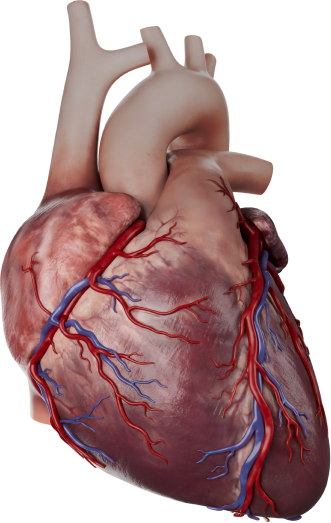
Normal heart
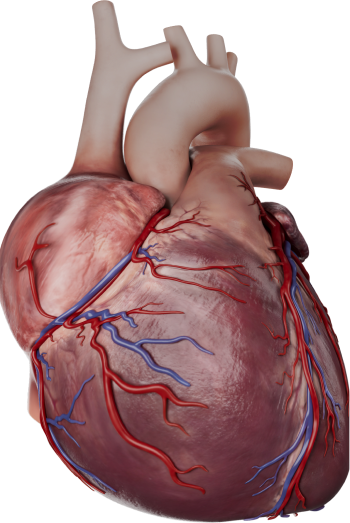
PAH heart
What is right-sided heart failure?
Right-sided heart failure occurs when the right ventricle loses its ability to efficiently pump blood into pulmonary circulation.1 In PAH, the RV works against progressively increasing afterload, eventually leading to decoupling of the heart and lungs.1 As the condition progresses, the heart muscle thickens to compensate, then stretches and enlarges under continued pressure, ultimately losing the ability to increase output during activity—causing extreme fatigue and shortness of breath, leading to eventual right-sided heart failure.1,5
Right heart involvement significantly affects survival: Patients with isolated left-sided heart failure have ~71% 2-year survival.6 However, with right-side involvement, the 2-year survival decreases to 23%.6 Aggressively managing hemodynamic markers to maintain low-risk status is essential for preventing right-sided heart failure and improving patient outcomes.3,4
Near-normalization of the right heart is a key treatment goal
A key PAH treatment goal is to help patients achieve and maintain near-normalization of the right side of the heart.3 Frequent, noninvasive right heart echoes and formal risk assessments form a strong foundation for understanding a patient’s right heart health.4,7 This combined approach helps inform timely treatment decisions that can help delay functional impairment and improve patient outcomes.3,4,7

“The right heart ... is the key to the whole game. [I]f we get near-normalization of the right heart, then we are in a really good spot to give the patients the best possible outcomes that they can have.”
— John Ryan, MD, BCH, BAO, Cardiologist
Hemodynamic improvement leads to improved prognosis
Right heart function is the primary determinant of survival in PAH. Improving hemodynamic parameters, and avoiding right-sided heart failure, is a direct means of improving patients’ risk status and outcomes.3 For example:
- Rapidly improving right heart structure, seen by reducing BNP to <50 ng/L, can help effectively reduce the strain caused by PAH4
- A multicenter, retrospective study of 267 PAH patients showed that mPAP ≤35 mm Hg predicted better survival than mPAP >35 mm Hg, with a 5-year survival rate of 94% vs 64%8
- Most of the many PAH treatments available today have shown benefits of improved hemodynamics and a positive effect on patient prognosis4,9
Establishing hemodynamic improvements early in the course of treatment serves as a bridge to optimizing long-term patient outcomes.3
Right heart changes can occur quickly
Lagging indicators: Although clinical parameters such as 6MWD and FC are commonly used to monitor patients with PAH, they are considered “lagging” indicators of disease progression, occurring after right heart changes occur. Similarly, these signs and symptoms often become apparent only after underlying right heart changes have already begun.10,11
Leading indicators: On the other hand, changes in right heart size, structure, and function are “leading” indicators that occur before clinical parameters are noticed.2,4,10-16
Because changes in the right heart can happen in as few as 12 weeks, regular, proactive monitoring can reveal how well a patient’s management plan is working and whether therapeutic modifications and escalation may be needed.12 Catching the subtle right heart changes early is key to improving patient functional ability and long-term prognosis.4,10,11,14
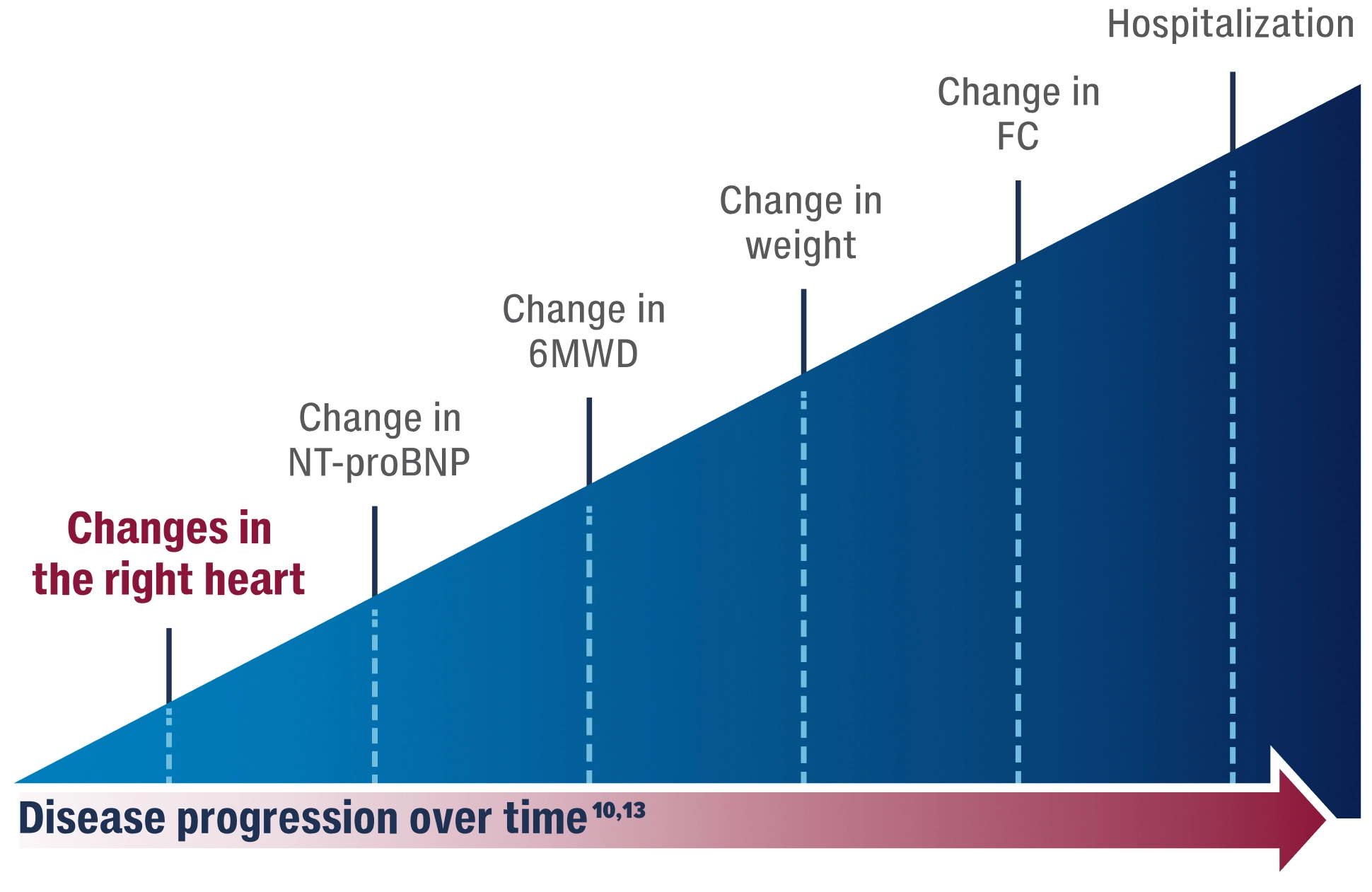
Changes in the right heart occur before clinical changes are evident.10,13
Disease progression over time10,13:
- Changes in the right heart
- Change in NT-proBNP
- Change in 6MWD
- Change in weight
- Change in FC
- Hospitalization

“I like thinking about the hierarchy of living systems … about organs, organ systems, and organisms. The organ that’s affected in PAH at the outset of disease is the lung and the lung circulation. As … lung circulation is diseased and the pulmonary vascular resistance goes up, that affects the right side of the heart. That’s your organ system: it’s the lung and the heart. I think of that as the leading indicator of the disease, and then, I think about things that stem from that and happen later.”
— Paul Forfia, MD, Cardiologist
Key tools to assess the right heart
Right heart catheterization (RHC) is the gold standard for confirming a PH diagnosis and providing precise measurements of right heart structure and hemodynamics4

Echoes track critical changes in right heart size, structure, and function before clinical symptoms are evident7

BNP, a biomarker, assesses real-time indication of right heart strain4

Today’s guidelines: Frequent echoes recommended
The evolving understanding of PAH disease and its progression reinforces right heart assessments as a critical aspect in managing patients. Because of mounting data, expert guidelines now highlight the critical role of frequent monitoring the right heart to determine treatment success for patients with PAH. The 2022 ESC/ERS Treatment Guidelines recommend right heart echoes every 3 to 6 months to monitor disease status following therapy changes or clinical worsening. Echoes should also be considered every 3 to 6 months in stable patients to ensure long-term stability and optimal patient outcomes.4
Routine echoes catch PAH progression
Transthoracic echoes (TTEs) remain the primary noninvasive tool for long-term monitoring of PAH and are essential for monitoring the hemodynamic changes associated with PAH. In addition, echo results can further stratify patients to give important prognostic information and inform treatment plans, particularly for those in the intermediate-risk group (eg, those with mild or moderate PAH).14,16
Routine echoes detect changes
Quick Clips!
Watch as Dr. Anjali Vaidya and Dr. John Ryan discuss how frequent echo assessments can lead to earlier detection of changes due to PAH.
View the video:
Pathophysiology of the Right Heart in PAH (11 min)
[Video title: The Echo in PAH: Routine Echos Detect Changes]
[On-screen text: John Ryan, MD, MB, BCH, BAO; Anjali Vaidya, MD, FACC, FASE, FACP; Excerpt from The Echo in PAH: State of the Art in Right Heart Monitoring]
[On-screen text: John Ryan, MD, MB, BCH, BAO, Associate Professor, Division of Cardiovascular Medicine, University of Utah; Director, Pulmonary Hypertension Center, University of Utah, Salt Lake City, Utah]
Dr. John Ryan: The changes in the right heart are the first things that will occur, and we don't necessarily have good ways of evaluating that, other than echocardiogram. Even these changes in the right heart will precede changes in N-terminal proBNP. A lot of us depend on N-terminal proBNP in clinic, following patients longitudinally. Then you'll get a change in 6-minute walk, then you'll get a change in weight, then you'll get a change in Functional Class, and then you'll get hospitalization.
So, we don't want to progress to change in Functional Class or change in hospitalization. We want to capture this early. So, performing a routine Echo may help catch patients whose pulmonary arterial hypertension is progressing before the symptoms are evident.
[On-screen text: Excerpt from The Echo in PAH: State of the Art in Right Heart Monitoring; View the entire program at www.RightHeartInPAH.com]
[On-screen text: PAH Initiative; Sponsored by United Therapeutics; PAHinitiative.com/hcp; © 2023 United Therapeutics Corporation. All rights reserved. US-DS-1105]
Treat to achieve near-normalization of the right heart4,11
Ongoing assessment of right heart parameters is critical because clinical symptoms may not be evident during early stages of right heart dysfunction, particularly RV dysfunction. When frequent monitoring reveals that the right heart is not at near-normalization, therapy adjustment is necessary to address the underlying pathophysiology and drive toward near-normalization to help improve patient outcomes.4,10-13
Therapy escalation should be considered if4:
- A patient has not reached low-risk status
- There is a decline in right heart parameters
- There has been insufficient improvement
Using a treatment regimen that targets multiple pathways with medications that have been shown to improve hemodynamic parameters helps reduce pulmonary arterial pressure and alleviate right heart dysfunction.3,4,17
By treating to the goal of near-normalization, clinicians can help patients move toward low-risk status to improve clinical status and long-term prognosis.4,7,10-13