
Advances in PAH
Advances in understanding pulmonary arterial hypertension (PAH) continue, constantly reshaping how we approach care and treatment of this challenging disease. PAH care decisions are now driven by combining the results of functional capacity, biomarkers, and hemodynamic parameters to forecast potential complications and estimate survival as part of a more comprehensive prognosis. This information provides the foundation for care and treatment plans today.1
The overall approach of PAH has shifted from a reactive “take action with decline” to a proactive, goal-based approach highly influenced by a patient’s calculated risk score and their right heart health. For most patients, the generally accepted treatment goals are achieving and maintaining low-risk status, ideally within the first year.1
Improve prognosis by achieving low-risk
The effort to understand patient prognosis is based on data collections from large, retrospective global registries that follow thousands of patients with PAH over long periods. These data help make informative predictions of patient survival according to their risk scores.2,3
Global registries consistently reveal that patients who achieve low-risk status, particularly in their first year after diagnosis, have a better likelihood of survival. Setting a treatment goal to achieve low-risk status in the first year of therapy can help give your patients a better long-term prognosis.3-6
For patients not at low risk, guidelines and consensus recommendations indicate treatment plan adjustments, including the addition of therapies from different treatment classes.1

“We have very well-established data now that tells us our goal should be to get a patient to low-risk status. We know that their prognosis is going to be much better if we get them there.”
— Vallerie McLaughlin, MD, Cardiologist
For example, as shown by data from the SPAHR Registry, patients who stayed at or improved to low risk at first follow-up had a significantly better 5-year survival rate than those who were intermediate or high risk.* These data validate the critical need for comprehensive risk assessments and the urgency to treat to achieve low-risk status in patients with PAH.4
*The median time from diagnosis to first follow-up was 4 (IQR 3-5) months, but within a year of diagnosis.4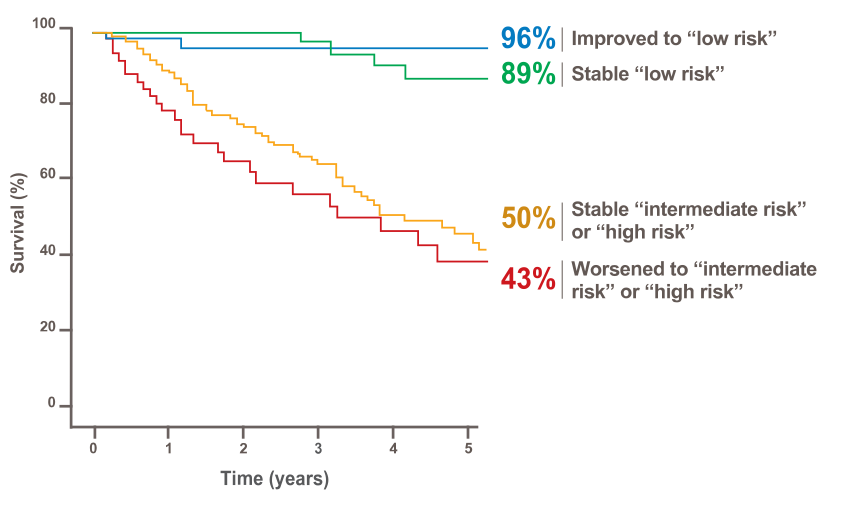
5-year Kaplan-Meier survival estimates based on risk category (P<0.001)4
- 96% of patients who improved to “low risk” were estimated to survive to 5 years
- 89% of patients who were stable “low risk” were estimated to survive to 5 years
- 50% of patients who were stable “intermediate risk” or “high risk” were estimated to survive to 5 years
- 43% of patients who worsened to “intermediate risk” or “high risk” were estimated to survive to 5 years
Guidelines recommend low-risk goal
Low-risk status is the PAH treatment goal established by 2022 ESC/ERS Treatment Guidelines and supported by the 2024 WSPH Proceedings.1,7 These recommendations are based on the compelling real-world data collected from more than 6000 patients during ~20 years in registries across the globe. By improving patients’ risk status, the data show that survival may be extended.1,3-6
Detailed registry information provided the data to generate risk assessment methods. Calculating a patient’s risk score consistently can help you determine your patient’s estimated survival and track their progress to low risk.1,7
Aim for low risk: Find the risk calculation method that will work for you and your practice
Examine Risk CalculatorsWhy is it critical to reach low risk in 1 year?
According to treatment guidelines, patients who are not at low risk at follow-up are considered to have an inadequate treatment response, and therapy escalation is recommended. While the baseline risk assessment informs the initial management plan, reassessment within 3 months is required to determine whether achieving low risk in the first year is likely. For patients not at low risk, making timely treatment adjustments is critical to their outcomes.1
Aim for low risk, even in intermediate-risk patients
Getting to low-risk status is critical for patient outcomes. In a study using the SPAHR Registry,* patients who did not reach low-risk status at first follow-up† were unlikely to achieve low-risk status in the following 2 years. Indeed, among patients who were at intermediate risk at year 1, only 12% made it to low risk by year 3, while 43% had either died or had a lung transplant by year 3.8
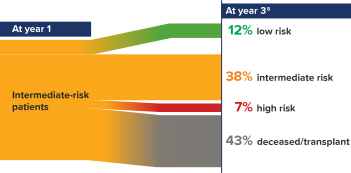
For patients at intermediate risk at year 18:
- 12% improved to low risk at year 3
- 38% remained at intermediate risk at year 3
- 7% worsened to high risk at year 3
- 43% were deceased or had undergone a transplant at year 3
Stable is not the same as low risk
In studies from the COMPERA Registry, patients who remained at intermediate-risk status from baseline assessment to follow-up (3 months to 2 years) had only a ~50% chance of survival over 5 years.3
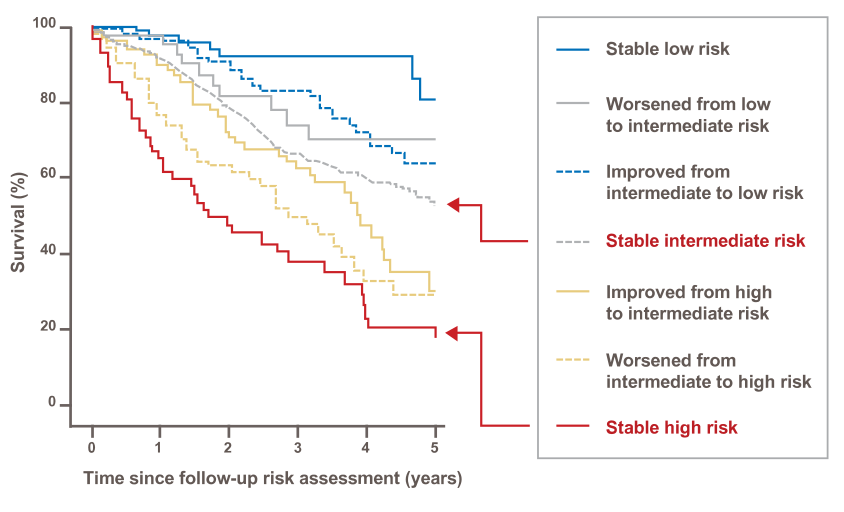
Impact on survival per change in risk category from baseline to follow-up (3 months to 2 years) in the COMPERA Registry3:
- Stable low-risk patients had the highest survival at 5 years
- Patients who worsened from low to intermediate risk had the next highest survival at 5 years
- Stable intermediate-risk patients had lower survival than patients who improved from intermediate risk to low risk
- Patients who worsened from intermediate to high risk had a lower survival than patients who improved from high to intermediate risk at 5 years
- Stable high-risk patients had the lowest survival at 5 years
It is important to remember that 2022 ESC/ERS Treatment Guidelines recommend that the treatment goal is to strive for low-risk status, not the perception of “stability.”1,9 Even when patients appear “stable,” the risk for disease progression exists.1,3 Calculating risk using a multiparameter method provides an objective measure of disease status.1
Extensive patient registry data informs prognosis
ESC/ERS Treatment Guidelines rely on both clinical trial data as well as data from registries to generate their recommendations.1 Multiple ongoing, retrospective registries from the US and Europe, including from Sweden and France, have collected countless data from more than 6000 patients with PAH. Each of these registries contains its own inherent nuances, as they reflect the varied populations and care systems from their specific countries.3-6
Consistent data span multiple registries
These rich datasets repeatedly demonstrate that patient survival rates improve when they achieve low-risk status. Across registries, patients who achieved or maintained low-risk status at first follow-up within 1 year after diagnosis had improved survival at 1 and 5 years.3-6,10* This improved prognosis is seen in spite of the intrinsic differences within the registries and serves to emphasize the strength of the data.
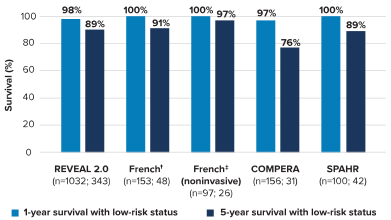
Survival of low-risk patients across registries.5*
1-year survival with low-risk status- SPAHR4: 100%
- COMPERA3: 97%
- French5: 100%†
- French5 (noninvasive): 100%‡
- REVEAL 2.06,10: 98%
- SPAHR4: 89%
- COMPERA3: 76%
- French5: 91%†
- French5 (noninvasive): 97%‡
- REVEAL 2.06,10: 89%
REVEAL and European registries support risk assessment calculations
Investigate Registries