
PAH Risk Assessment

Risk assessment for PAH

Risk assessment is a critical component of a guidelines-supported, goal-oriented, comprehensive treatment approach for patients with pulmonary arterial hypertension (PAH). Risk‑assessing your patients at diagnosis and every 3 months throughout their care helps you predict their survival, assess their progress toward treatment goals, and determine time when treatment adjustments are needed.1

What is risk assessment?

Risk assessment is a mathematical method to combine patient variables and estimate their mortality risk. Risk assessment provides an objective means to evaluate your patient’s disease status and estimate their prognosis.1,2 Knowing a patient’s calculated risk score informs treatment goals, medication regimens, and monitoring decisions.1,2 A risk score is derived from a variety of inputs—including clinical and functional assessments, biomarkers, Echo measurements, and hemodynamic parameters—to estimate their risk of death (or, conversely, their chance of survival) over 5 years.1,3,4

Risk assessment built on large registries

As a rare disease, PAH has been difficult to study. Multicenter, observational registries focused on PAH were initiated in countries around the world to study the course of disease and disease management. Risk assessment methodologies are based on these robust, multicenter registry data of patients with PAH.2,5 Registries include the US-based REVEAL and the European-based COMPERA, French, and SPAHR databases.5-7

Risk assessment is based on parameters collected from these large, longitudinal databases of real-world patients.5-7 Using consistent patient variables and registry-specific algorithms, survival of patients with PAH can be predicted up to 5 years from diagnosis.1,3,4,7

These calculations—or risk scores—indicate the prognosis of patients at various risk strata based on inputted patient variables.7

Calculate risk using online risk calculators

Explore Risk Calculators
Podcast icon

The Importance of Risk Assessment

Discover why formal risk calculations are essential and the latest tools available to you.

Dr. Raymond Benza: Welcome to the Pulmonary Arterial Hypertension Initiative podcast. This podcast is sponsored by and the presenters are being compensated by United Therapeutics. In this series of podcasts, we will talk about how PAH treatment guidelines and risk calculation drive treatment decisions in pulmonary arterial hypertension, as well as their own experience in treating our patients with PAH. My name is Dr. Raymond Benza.. And I have the pleasure of being with one of my longtime colleagues, Dr. Vallerie McLaughlin.

Dr. Vallerie McLaughlin: Hi Ray. It's great to be here. I'm looking forward to this podcast.

Dr. Raymond Benza: Thanks Val. In today's program, we will be discussing the importance of risk assessment and pulmonary arterial hypertension management. According to the PAH treatment guidelines, risk assessments should be driving our initial therapy choices as well as any changes in therapy. So let's get started. So Val, can you describe to me what risk assessment is all about in pulmonary arterial hypertension?

Dr. Vallerie McLaughlin: Yeah. Ray. I think that we as cardiologists have really incorporated risk assessment into really many different diseases. We use different scores for NSTEMIs and STEMIs, and CHADSVASC for AFib. We live this, this is really something that is important to objectively care for patients. And over the years, we have learned about the important parameters that are prognosticative in patients with pulmonary arterial hypertension. We've learned from many databases that have included thousands of patients, the parameters that assess a patient's risk or the severity of their illness and what their likelihood is of having an event over time. I think the multiparameter approach is really critical because this is a very complex disease and there are many different predictors, including how the patient is feeling, whether or not their right ventricle is failing, what their symptoms are like, syncope, how dyspneic they are, what their Functional Class is. Those are all clinical assessments of other patients. Echo has not been incorporated as much as I would like to see it.

We are really just more recently getting savvy about quantitating right ventricular function. I think we both know how that right ventricle function is really critical in terms of the outcomes of PAH patients. And then of course, hemodynamics are important. They define the disease and also reflect the function of the right ventricle. And so when we talk about a multiparameter risk assessment, we're looking at many of those different parameters and trying to assess whether we think our patient is at low, intermediate, or high risk over the ensuing years. And we learned from each registry that no matter what the treatment is, our goal for the patients to reassess their risk and to drive them into that low-risk status. Ray, is this your approach as well?

Dr. Raymond Benza: It is my approach. And I think you really eloquently described the available nuances that we take into consideration when we do these assessments of risk, including very importantly, the multiparameter approach. We never hang our hat on just one variable. And I also wanted to really emphasize the piece about imaging because, as we'll talk about it a little bit later, many of the contemporary tools that we have lack sophisticated imaging parameters as part of them. And I think the tools that we have and that we use and that we will describe later, have to be really used in conjunction with some of these other newer things that are coming out that we think are important, but achieving low risk and using the multiparameter approach, I think of the 2 salient issues that I really would like our practicing clinicians to take away from this.

Dr. Vallerie McLaughlin: Yeah. I agree. Let's talk about how often we should be performing those risk assessments. What's your approach to that?

Dr. Raymond Benza: I think at least at baseline is probably one of the most important parts of risk stratification. Really, when a patient comes to your clinic for the first time, they may not have been on therapy. They're just newly diagnosed. They're really assessing their baseline risk; it’s very, very important. Not only for the treatments that we decide to place them on, but also for the patient's information and their own means to plan their lives for the next year or 2. And then after that initial assessment, and I think at minimum, every 3 to 6 months, we should be evaluating our patients, but I'd like to get your opinion on a more detailed approach and maybe peaking at a patient every time we see him in our clinic. What do you think about doing risk assessments even in our routine clinic?

Dr. Vallerie McLaughlin: Oh, Ray. I think that's really key. I do that every single time I see a patient, I think pretty much every encounter we had and a patient, it's an opportunity to assess their risk and consider whether or not we've gotten them into that low-risk status because that's where we want them. So we can look forward and have confidence that they're going to do well. So Ray, there are lots of ways to assess risk. Maybe we should go on and talk about some of those methods and you were really the genius behind REVEAL risk calculators. Why don't I talk about the ERS approach, ESC approach, and the French approach. And you talk about REVEAL, if that's okay with you?

Dr. Raymond Benza: That's perfect Val.

Dr. Vallerie McLaughlin: Yeah. The ESC and ERS guidelines published this table, the very famous table. Green, yellow, red stoplight sort of table about a number of different prognosticators in pulmonary arterial hypertension and cut points that put them at low, intermediate, or high risk. Most of these are derived from registry data. Some of them are derived from gestalt, right? Like syncope is really a gestalt thing and an observation that we've made, but not really included in registries. So the important determinants include Functional Class. So we know patients who have Functional Class 4 symptoms do very, very poorly and Functional Class 1 and 2 do well, and Functional Class 3 sort of in the middle. We have discussed hall walk already, the exercise tolerance, objective exercise tolerance is something that's very important and that can tell us about a patient's prognosis. So greater than that sort of magic 440 number of patients do well, less than the mid-100 patients do poorly.

The Echo data and well, this is different; something I actually would like to talk to you about. The Echo data in all of these is really very limited. The presence of a pericardial effusion, which has been published a few times and the size of the right atrium—that's really the data that we have from registries that go into these scores. When I do an Echo on a patient, I go look at that right ventricle. It really is very meaningful to me and, I think, anyone who has experience in this disease. I think that it's unfortunate that many registries don't have a quantification of right ventricular function. Not all Echo labs quantify right ventricular function. I just thought maybe you'd want to comment on that, Ray, before we move on.

Dr. Raymond Benza: Oh no, I agree with you 100%, Val. I think all the tools that we have developed were developed in eras when imaging wasn't as prominent as a known risk player in prognosticating. And I agree with you that as these risk scores and equations evolve, that I would love to see more imaging data in the scoring systems. And I think the important thing about that is if you really look at the spectrum on how a patient evolves or progressed this with PAH, we have changes in pressure that then lead to changes in the right ventricle. And these changes can occur very early, even before many of the other symptoms or variables that are accounted for. So it even might add a level of greater sophistication and predictability for early decompensation by including these imaging parameters, entities, contemporary scoring systems that we have.

But ultimately, I think that it's the combination of these things that are important, as you mentioned earlier, the ESC and ERS guidelines and even the French method, which use a number of variables that are within the guidelines. There are some differences between the calculators that we have developed in the REVEAL, but I was curious if you might want to go into a little bit more about some of the French methodology for calculating risks before I went into what we do with REVEAL.

Dr. Vallerie McLaughlin: Yeah, for sure. In fact, let me just make a couple more comments on ERS, ESC. So we talked about the syncope, right ventricular failure, Functional Class, hall walk or cardiopulmonary exercise testing PCO2 is listed. Biomarkers are also included BNP less than 50, NT-proBNP less than 300. Very good prognostic indicators puts the patient in a low risk. Whereas if the BNP is greater than 300 or NT-proBNP is greater than 1400, that puts the patient in a higher risk. And then of course, hemodynamics are also important in terms of risk. And we've known for many years, and this point is emphasized in the risk assessments. It's not what the pulmonary artery pressure is. It is how the right ventricle is coping with that pulmonary artery pressure. So, right atrial pressure, cardiac index, and SPO2 are the hemodynamic parameters that are most predictive. So, that's the ERS, ESC approach.

Now the French approach, which I really like, is very simple. They took a different approach. They basically said, these are the 4 factors that are most important to us. And it has to do with being in Functional Class 1 or 2, having a hall walk over 440, having a cardiac index greater than 2.5, and a right atrial pressure less than 8. And so those are the 4 factors using the invasive French approach that they look at. And if you have 3 or 4 of those 4 factors, your prognosis is very good. Whereas if you have less than that, the prognosis is quite poor.

And then when they had a subgroup of patients that also had biomarkers and they can incorporate the BNP or NT-proBNP, when you put that into the multivariate analysis, the right atrial pressure and cardiac index falls off. And so the noninvasive French is really just Functional Class, hall walk, and biomarkers. And at least for me, that's something I do in clinic every time I see a patient. I have all 3 of those parameters every time I see a patient. So that's the noninvasive French approach. Ray, you want to tell us about REVEAL?

Dr. Raymond Benza: Yeah. Thanks Val. So REVEAL calculators are in essence, very similar to the ESC/ERS guidelines and the French method in that they both use very similar variables. And that's good because that tells us that all the contemporary restratification scoring and systems that we use are complimentary. And we could feel safe using them because many of the variables are shared. REVEAL takes it just a little bit further down kind of the statistical pathway, than the guideline or French method in that REVEAL methodologies are really derived from very standardized statistical modeling. And very importantly, that the variables that are used in these scoring systems are weighted against each other so that the relative importance of one variable versus another. For example, the Functional Class may be more or less important than an NT-proBNP level. So it kind of gives you a way to really summate the risk with a little bit more sophistication than some of the European methods.

So REVEAL Lite 2 is the derivation of an earlier model called REVEAL 1.0, and what REVEAL 2.0 did is, it took a lot of the same variables that we had found in the original REVEAL 1.0 calculator. Which contains both demographic vital signs and other more objective measurements and add it to that hospitalization and the risk that is imparted by recent hospitalization for pulmonary hypertension and heart failure. It gave us some more objective means of measuring renal function, which we know comorbidities are very important part of risk stratification and renal function is one of the very important ones that have been highlighted and uses a GFR and then set of a subjective assessment of renal insufficiency. And also changes some of the scoring points and actually add a more of a dynamic nature to the changeable risk factors like BNP and the 6-minute hall tests.

So it takes those variables and then weights them And you can calculate a score that very nicely discriminates between low, intermediate, and high risk. Now, the difference between REVEAL 2.0 and REVEAL 2.0 Lite is just the number of variables that's required to make the calculation. The parent score, which is the REVEAL 2.0, scores 13 variables that are associated with it. And these contain some immutable risk factors. The factors that don't change over time, like a patient type of pulmonary hypertension that they have and their gender and age, even though age does change the risk points, here it is a kind of a combination of age and gender. And then it has a number of easy-to-discern variables, including vital signs like low blood pressure or high heart rate combined with the Functional Class NT-proBNP levels in which there are several cut points and 6-minute walk distance, which also has several cut points.

And then add that the Functional Class and Echo estimates of pericardial effusion that you mentioned earlier, and then hemodynamics, which include importantly, the right atrial pressure and the pulmonary vascular resistance. And then REVEAL Lite, take the parent calculator and really strip it down to the easily obtainable, changeable variables that you can assimilate in each clinical encounter. Very similar to the French method and that it uses vital signs, Functional Class, the hall walk test, the NT-proBNP levels, and the vital sign. But the big differences, as we mentioned earlier, is that these factors continue to be weighted against each other, such that the discrimination index with these more statistically derived methods are a little bit higher than those that don't incorporate weighting. Well, I hope those descriptions of the algorithm and calculators were helpful to the audience, but I'd like to ask Dr. McLaughlin, if she has any further opinions or statements that you wanted to make about the formal risks calculations that we make?

Dr. Vallerie McLaughlin: I think that was a really elegant discussion of how REVEAL was developed. And one thing I want to highlight is the difference between 2.0 and 2.0 Lite, including the nonmodifiable risk factors. I think when we have nonmodifiable risk factors in a risk calculator is an excellent way to predict prognosis. In fact, I think there's probably nothing more accurate at actually predicting prognosis than REVEAL 2.0. But sometimes when we think of driving people to low risk, we get a little challenged because there are so many nonmodifiable risk factors in it that, sometimes our patients are going to be at very high risk, no matter what we do. And that I think is one of the things that we've discussed over the years about using calculators and driving patients to the low-risk status. And I think REVEAL 2.0 Lite very nicely addresses that issue and really includes the risk factors that you can treat with medical therapies and have success at trying to drive patients into a low-risk status.

I think that's a really important differentiation and in fact, REVEAL 2.0 Lite and French are very similar with the exception of the additional parameters of vital signs and kidney function. I think we've discussed 4 different tools and they're all very good. They're all very meaningful. If you get into low-risk status with any of those tools on therapy, no matter what the therapy is, the patient's prognosis is good and that's what we're looking for to improve the patient outcomes. And so that leads us to the next discussion point. We have this really wonderful data from all of these risk calculators that show if we can get them to low risk, they do well. So let's talk a little bit about why it's so important to use a formal risk calculator rather than just the gestalt. Do you have any comments on that, Ray?

Dr. Raymond Benza: Yeah. Thank you Val, for pointing that out. I think that is really important. And as we mentioned earlier in the talk, these tools are very complimentary to each other, and I think that can be used together a more formalized, detailed risk assessment would REVEAL 2.0 perhaps at baseline and maybe at a year. And then when you're doing the peak of patient, like you mentioned earlier, watching them at each one of their clinical visits, maybe that's the time where you can implement the French method or REVEAL Lite. To get those on the fly risk assessments, just so that you make sure that you are actually plotting the trajectory correctly. Clinical gestalt, they think can really mislead us in certain circumstances. Now we even have a recent study that compared clinical gestalt and the form of risk calculation, and by reviewing patient's charts from clinicians who treat patients with PAH. And both clinical gestalt and the calculated risk were aligned in less than half of the 365 charts that they examine.

I've found that very surprising 80% of the patients that are estimated to be low risk by clinical gestalt were actually reassigned to a higher risk category and perform a risk calculation. That's really important because underestimating risk is where patients can really be hurt because that's where you would use as an intensive mode of therapy, as opposed if they were really low risks. So that's a really important thing is just not to miss the intermediate or high-risk patients by utilizing a less nuanced way of predicting risk. And I think there have been other studies that looked at formal risk calculation in these earlier patients functional two class patients.

And I believe a retrospective chart analysis of 153 Functional Class 2 patients who were either on mono- or dual combination therapy. And more than half of the Functional 2 patients were classified as intermediate or high risk when the risk was calculated. So again, these are patients whom if we use the single variable of assessment like Functional Class or even clinical gestalt, we would have underestimated their risks and perhaps not put them on the intensity of therapy that the patients deserve to be on.

Dr. Vallerie McLaughlin: I think those are great points, Ray, and I think we always have to have some common sense, some gestalt in medicine, but this is an example where risk calculators are helpful. But I might point out Functional Class, as we've talked about, is subjective. Maybe a patient sounds Functional Class 2 because they've limited their activities so much that they don't get short of breath. A really skilled historian can try to dig that out, but sometimes patients just adapt in it. It's also leads to the next topic of discussion is relying too much on one thing such as Functional Class. I mean, for many years before we had all of these additional tools and all of the additional data about BNP and what have you, Functional Class was the holy grail and it's something that's easy. It's inexpensive, we do it every single time we see a patient. But it's not enough, is it?

Dr. Raymond Benza: No, it's not. And it's like you said, we uproot the weed on Functional Classes, cardiology fellows. And it's been ingrained into the way that we evaluate our heart failure patients, but it is the bottom-line subjective. It really relies on patient input, their memory, and even their honesty at some point. And so this objective evaluation really has to be weighted and thought of in a different manner. The formal risk assessment is objective. We're talking about multiple parameters. Some that are objectively measured, but not subjectively measured like human dynamics or vital signs or pericardial effusion on an echo or an NT-proBNP level. So, balancing these subjective with objective factors I think is very good, but I don't want to short come the Functional Class because even despite its subjective nature and every risk calculator and every assessment we have done, it's always peaked its head is something that is important. It may not be as discriminatory as the others, but it certainly remains important.

Dr. Vallerie McLaughlin: Yeah, no question. Now, some people who are critics of this say, "Oh my gosh, it takes so much time. You have a limited amount of time with a patient appointment and epic or the electronic medical record makes it all so complex. I don't have the time to do this over the course of a visit." And I think that's really not a very good excuse to do something that is so important and so prognostic for a patient. A French invasive or noninvasive is really for 3 variables. It really doesn't take that much time. And Ray, I know that you've actually gone to a lot of trouble trying to develop apps to make the REVEAL calculation easy as well.

Dr. Raymond Benza: Yeah. So, there are apps that are currently available. There are websites that are available that can calculate the risk for you. We've made a lot of headway in some of the EMR and programming them to calculate risks on the fly. So I think the nature of the calculation is getting easier and easier for practitioners to perform. But like you mentioned, doing a risk calculation using REVEAL Lite 2, or the French method that can be done in less than 30 seconds. So it really is very, very easy to do and my practice, my nurse coordinators calculate the risk before I even walk into the room. And so it's readily available for me to talk with the patient about and discuss and make critical decisions on.

Dr. Vallerie McLaughlin: Yeah. Ray, I think you've contributed so much to this area. It's really been a delight to have this conversation with you. I think to wrap up, we've really emphasized that formal risk calculations are important to help us monitor our patients and choose the appropriate therapy for them. So it's been such a pleasure and this concludes our first PAH initiative podcast. Please join us next time when we will discuss initial therapy choices based on risk calculation.

Risk assessment guides treatment

Essentially, risk assessment helps you set and measure objective treatment goals so you can determine treatment plans and evaluate success.1 It is the foundation from which the PAH guidelines build their care plan recommendations.1,7 According to treatment guidelines, achieving and maintaining low-risk status is the primary treatment goal for patients with PAH.1 Patients who achieve this goal improve their likelihood of survival, which underscores why treatment adjustment is needed for patients who are not at low risk at first follow-up.1,3

Predictions using risk assessment

Risk assessment helps predict clinical worsening in patients with at least 1 year of follow-up data. Using REVEAL 2.0, a 0-4 risk score predicts a greater percentage of those patients will be free from clinical worsening than patients with risk scores of 5-6 (hazard ratio, 1.23; 95% confidence interval, 1.21-1.25).2

Risk assessment also helps predict survival. In the French Registry, transplant-free survival was assessed by the number of low-risk criteria present at first re-evaluation in patients (N=1017).6

  • Low-risk parameters investigated6:
    • WHO/NYHA FC I/II
    • 6MWD >440 m
    • RAP <8 mm Hg
    • CI ≥2.5 L/min/m2
  • Patients who achieved low-risk status for all 4 parameters at first follow-up within 1 year after diagnosis had 91% transplant-free survival over 5 years.6
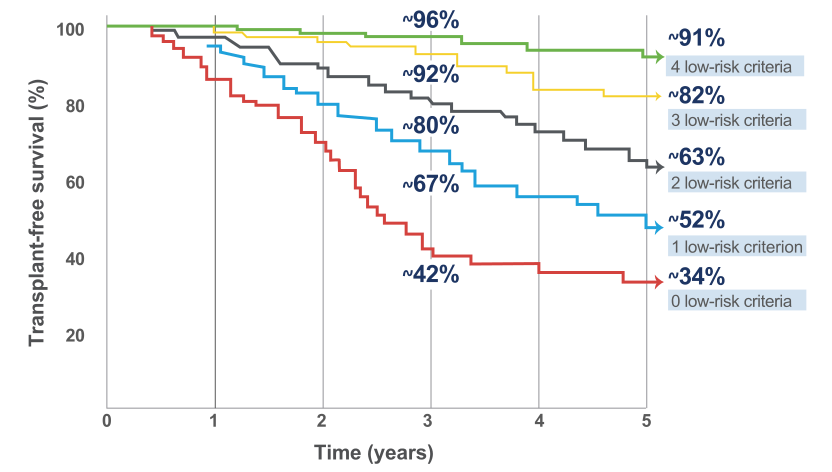
Kaplan-Meier transplant-free survival estimates at follow-up (P<0.001)6
Kaplan-Meier transplant-free PAH survival risk assessment graph
Image Description

Kaplan-Meier transplant-free survival estimates at follow-up (P<0.001)6:

  • 4 low-risk criteria: Transplant-free survival (%) is ~96% at 3 years and ~91% at 5 years
  • 3 low-risk criteria: Transplant-free survival (%) is ~92% at 3 years and ~82% at 5 years
  • 2 low-risk criteria: Transplant-free survival (%) is ~80% at 3 years and ~63% at 5 years
  • 1 low-risk criterion: Transplant-free survival (%) is ~67% at 3 years and ~52% at 5 years
  • 0 low-risk criteria: Transplant-free survival (%) is ~42% at 3 years and ~34% at 5 years
Adapted from Boucly A, et al. Eur Respir J. 2017;50(2):1700889.

Why is risk assessment foundational to care decisions?

Risk assessment guides treatment and monitoring plans to help patients reach low risk.5,7

Risk assessment provides timely guidance

Since PAH can progress rapidly without outward signs of worsening, regular risk assessment can provide timely guidance for patient care.8-10 A formal risk assessment using an objective methodology is established at baseline, re-assessed within 3 months of initiating therapy, and repeated every 3 to 6 months to follow your patient’s progress and catch disease progression.1

Applying risk assessments throughout your patient’s treatment journey will provide information to help you modify their care plan, with the goal of achieving low-risk status. Risk assessment guides treatment decisions, with the opportunity to improve prognosis, particularly when the low-risk goal is met in the first year of diagnosis. 2,3,7

“Never before has risk assessment been woven throughout the entirety of guidelines. Very, very important. Important to assess risk at baseline, which we’ve done. Equally important to reassess patients frequently, generally every three to six months, with risk reassessment at that time as well—our goal being to drive risk to the low-risk category. And only with frequent reassessment is that possible.”

Scott Visovatti, MD, Associate Professor of Medicine and Director, Pulmonary Hypertension Program, Ohio State University, Columbus, OH

Today’s treatment goals: low-risk status and near-normalization of right heart1,11

Achieving and maintaining low risk is the primary treatment goal set by the 2022 ESC/ERS Guidelines and supported by the 2024 WSPH proceedings for patients with PAH.1,11 Additionally, striving for near-normalization of right heart is critical for patient management, as survival is linked to improvement of right heart function.11 Risk assessment provides an objective means to monitor and assess how your patient is moving toward these goals.1,2

Historically, treatment decisions were based on monitoring a patient’s symptoms and escalating therapy when patients showed signs of decline. The approach to treatment has evolved dramatically. Today’s approach uses objective methods to predict outcomes.1,2 With these outcomes, providers can proactively manage treatment plans against specific goals, rather than reactively adjust when patients decline.

According to treatment guidelines, risk assessment should be conducted at diagnosis and then every 3 to 6 months.1 This allows you to1:

  • Identify your patient’s prognosis, and set treatment goals
  • Determine your patient’s initial treatment regimen
  • Objectively monitor your patient’s response to treatment
  • Identify RV changes before symptomatic progression
  • Escalate therapy to improve risk status when not at low risk

Baseline risk assessment at diagnosis

No single patient variable can give enough information to determine management and care.11 At diagnosis, ESC/ERS Treatment Guidelines and 7th WSPH Proceedings recommend evaluating multiple patient parameters, including data collected from clinical assessments, biomarkers, exercise tests, hemodynamics, and Echo evaluations.1,11,12

Robust assessment required at diagnosis

Gathering as much data as possible at diagnosis establishes a strong, comprehensive baseline of your patient’s risk status. This information allows you to objectively assess the severity of their disease, predict their prognosis, and set their initial treatment plan.1,11,12 Knowing where your patient is starting from helps inform your management decisions to move them toward the goals of low-risk status and near-normalization of the right heart in their first year of treatment.1,3,11,12

Multiparameter risk calculations are the foundation of patient care plans

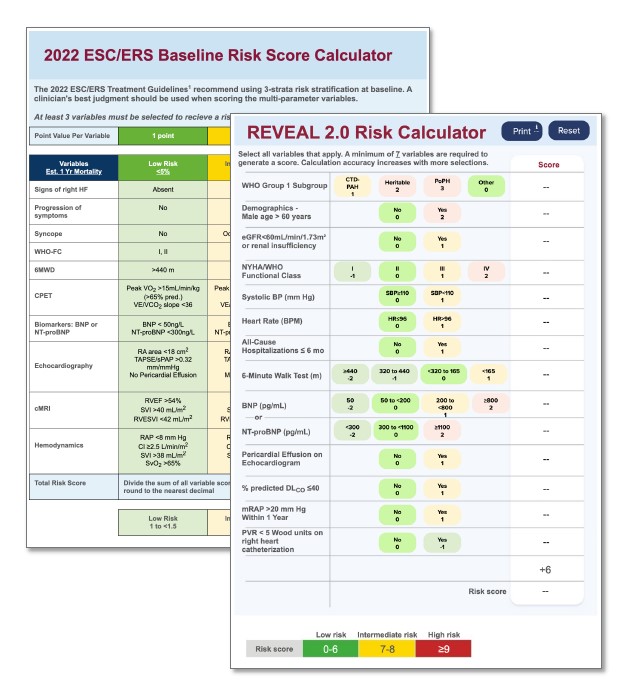
An objective, multiparameter risk calculation completed upon diagnosis establishes the patient's baseline risk status.1,11,12 Experts recommend using as many parameters as possible for this evaluation, which should at least include disease type, 6MWD, hemodynamics, NT-proBNP, and WHO FC.1,11

Examples of parameters included in risk assessment1

WHO FC

6MWD

NT-proBNP plasma levels

Clinical signs of right heart failure

Syncope

Hemodynamics

Imaging (Echo, CMRI)

Progression of symptoms

Importantly, the results of a multiparameter risk calculation guides both treatment goals and initial treatment regimen. They can also be used to formulate your plans for monitoring your patient.1,2

REVEAL 2.0 Risk Calculator and 2022 ESC/ERS Baseline Risk Score Calculator are multiparameter risk calculators for initial, baseline patient risk assessment.11
Podcast icon

Initial Therapy Choices and Treatment Goals

Learn how our hosts determine initial therapy for their patients.

Dr. Vallerie McLaughlin: Hello, and welcome to this PAH Initiative podcast. This podcast is sponsored by and the presenters are being compensated by United Therapeutics. In this series of podcasts, we will talk about how PAH treatment guidelines and risk calculation drive treatment decisions in PAH, as well as our own experiences in treating our patients with PAH. I'm Dr. Vallerie McLaughlin

Dr. Raymond Benza: And I'm Dr. Raymond Benza. It's a real pleasure to be here with my close colleague, Dr. McLaughlin.

Dr. Vallerie McLaughlin: Ray, it's always a pleasure to work with you. I really enjoyed our first podcast during which we discussed the importance of risk assessment in PAH management. In this program, the second in our series of podcasts, we're going to discuss initial therapy choices based on risk assessment. So let's get started with that. Ray, let's say you've just met a patient, you've just diagnosed a patient with PAH, how do you determine their initial treatment plan? There's so many things to consider and so many agents that are now available to treat PAH. What's your approach?

Dr. Raymond Benza: Well, I agree with you. I think that's one of the nice things about treating pulmonary arterial hypertension in this era is that we do have so many available agents to treat this disease. As you know, when we both trained, there was only 1 therapy for this disease, and now we have at least 12 to choose from. So, understanding how to use these medicines intelligently to both make patients feel better, function better, I think is really important. And I think the common ways that we do that now, as we talked about in our first podcast is to really use a multidimensional approach that evaluates a person's summated risk, and then base our treatment therapies on that summated risk, whether you use the REVEAL calculator or one of the European systems, this multidimensional risk paradigm is really very important.

And I think the guidelines say that most patients who are judged low or intermediate risk should receive upfront oral combination therapy, and that those who are at high risk conversely, should really receive combination therapy that includes an IV prostacyclin-class therapy. And then again, as we mentioned in our first podcast, our treatment goal is really to get patients to low risk and then monitor them continuously. And again, always reassessing, always trying to drive them to this low-risk goal, because we know that that improves not only mortality for these patients, but also makes it a much less morbid disease. they're functioning better in their own home environments.

Dr. Vallerie McLaughlin: Yeah, I think that was a great summary, Ray. So I agree. In my practice, probably a very small proportion, maybe less than 10% of patients are at such high risk would we make the diagnosis that they go onto parenteral prostacyclin therapy as part of their combination therapy. The vast majority of patients are intermediate risk and there are some low risk. And we use upfront combination therapy generally with an ERA and PDE5 to start out with in most of our patients. What's your practice, Ray?

Dr. Raymond Benza: I agree with you. I think we need to be very careful in this category. One, because we know that PAH is a progressive disease, and we want to make sure that we halt this disease in its track. And just the combination of several medications really seems to do a good job trying to really slow down the disease. But as you mentioned, there are few people who can be started on monotherapy. And I believe these are the people who are extremely low risk. For example, having 4 of the low-risk factors by the European methods or REVEAL score less than or equal to 5. These people usually have a low risk, both of morbidity and mortality, and may be an ideal patient to use monotherapy on. But again, I want to caution everyone that when you use these multimodality risk factor parameters, as we mentioned in our first podcast, you should use these together both with your clinical gestalt and with other modalities that are not defined in these contemporary restratification systems, particularly imaging of the right ventricle.

So if I see someone who's low risk, but their right ventricle is still not looking good, that's not a patient for monotherapy. These are people who usually have really well preserved, right ventricular function. They're low risk by these contemporary scores, which includes a low Functional Class, a low pulmonary vascular resistance, a low mean pulmonary artery pressure, and as I mentioned and stressed, a normal right ventricle at Echo. And we have had people who've been treated with monotherapy for more than 5 to 10 years on a long-term basis and are stable with a low-risk profile. But the key is here, you have to continually reassess to make sure that these patients that you're treating with a singular drug really stay low risk in the long term. So again, constant reassessment, as we talked about in the first podcast is really, really very important. And then obviously, as you mentioned, Val, when combination therapy is either unavailable or contraindicated, because a patient may have severe liver disease as an example, that you get may be an indication for that. Therefore, monotherapy is really the exception and not the rule.

Dr. Vallerie McLaughlin: Yeah. I think that was a really wonderful summary, Ray. I just want to focus a minute on those low-risk patients. We're still recommending combination therapy on low- and intermediate-risk patients with the exception of some of these patients with extraordinarily low-risk status that you described. Those patients, at least in my practice, are few and far between. Ray, what's your experience?

Dr. Raymond Benza: Oh, no, I agree with you. And that's why I really want to issue this word of caution to be really careful that you really scrutinize this low risk to the highest extent that you can, because you don't want to do these patients a disservice. Just was going to agree with you, Val that my experience actually, very, very few patients are in this very low-risk status as you mentioned. So caution, I think is the key word here.

Dr. Vallerie McLaughlin: Yeah. I would say the patient population that I tend to see in that very low-risk status at the time of diagnosis are those patients who are very aggressively screened in our scleroderma clinic and they get diagnosed with PAH with a mean pulmonary artery pressure in the low 20s and a pulmonary vascular resistance of just barely over 3, with a normal right ventricle. Don't see them that often, but that's the group that I tend to see them in. But let's say, Ray, you diagnose a patient, you start them on a treatment plan. We have really emphasized the goal of getting them to a low-risk status. How do you monitor them? What's your approach to reassessing them for that risk status? And how do you approach the continued management after that first initial treatment decision?

Dr. Raymond Benza: Well, as we mentioned, Val, and you and I had this really great discourse in that first podcast, that really achieving the low-risk status is our goal. And this is supported by multiple registries looking at thousands of patients. And we know that people who achieve low-risk status live longer, function better than those who remain at intermediate or high risk. So that's something that's always got to be in the background when you're evaluating these patients on a continual basis. And that again is the really key piece here. These are patients that you just can't see, start them on a medication or walk away with them. They need to be constantly reevaluated, constantly restratified. And as we mentioned in our first podcast, using very simple algorithms like the European low-risk criteria or REVEAL Lite 2, which has very simple to garner modifiable factors, we can really restratify them every time we see them in clinic, or even over the telephone in some instances, to make sure that their trajectory is following the path that we want them to.

But certainly we want to officially see these patients after starting them on new therapy, certainly within 3 to 4 months to do a good risk assessment, probably using an imaging modality in addition to the contemporary restratification systems that we do. Some people, if they're moving really aggressively in the wrong direction, could add another set of hemodynamics to that, again to reassess the patient in totality, to make sure that we're pushing them into low-risk status. And if we're not, then we need to intensify therapy to really get them moving in the right direction.

Dr. Vallerie McLaughlin: Yeah, I agree with that, Ray, and I just want to emphasize one point, and that is the timeline. I would have to say that my practice has evolved to be a little bit more on the aggressive side. We do a nurse practitioner virtual visit at 1 month just to make sure they're tolerating the therapies well. We find that that helps with retention on therapy. We can talk them through some side effects, and I'm now really leaning toward that 3-month time point to bring them back into the office and reassess their risk and decide if we need to escalate therapy. So I think that is really important, as you've emphasized, get them to low risk.

And I think it's 3 months for... I think 6 is stretching it, but let's move on to aligning goals. We're physicians, we have studied this, we have this vision of improving long-term outcomes of our patients. And we know with all the data that you have reviewed that getting them into the low-risk status improves their outcomes, but really what the patients want is to feel better, right? They come to us, [inaudible 00:11:38] they come to us not being able to go up the stairs. What they want is to feel better. They want to feel less short of breath. They don't want to have a lot of side-effect medications. We really need to align our treatment goals with the patient's lifestyle goals and their goals for their everyday day-to-day living. Can you tell me a little bit, Ray, about how you incorporate that in your practice?

Dr. Raymond Benza: Yeah, Val, I think of the many things that we've talked about today, this is one of the most important aspects of therapy that is often neglected. Patients have to be involved in your decision making at every point. Physicians at times, get too focused on mortality and morbidity and really what the patient wants is, as you mentioned, they want to feel better. They want to breathe easier. So incorporating the symptoms in your treatment paradigms are really important. And we use simple tools like the emphasis questionnaire, or even sometimes even more complex questionnaires to really get a good idea how the patient's really in functioning and feeling in their own environment. And we use these quality-of-life measures in determining how aggressive we need to be. Is there a balance between side effects of medications when they're on combination therapy where they're not really feeling well because of side effects? So you really have to take the balance of how a patient feels from a quality-life-perspective and the intensity and aggressiveness of your medical management.

Dr. Vallerie McLaughlin: Yeah, I think that was well said, Ray, and I think it's really critical to involve the patients. I did a video visit earlier today on a 19-year-old gentleman with heritable disease. He's not where we want. And probably one of my most important questions to him is, “Tell me what you want to do that you can't do right now” and setting those goals, trying to figure out what it is the patients want in their lifestyle and how to balance that with the side effects of the drug. So, it's really critical. And I would also want to emphasize that this is a tremendous opportunity to involve the rest of our allied healthcare professionals. Many of these medications have side effects that are complex to manage, and sometimes patients give a little more information to nurses and nurse practitioners than they do to physicians. And I feel very fortunate and I suspect you are as well, Ray, to have such a wonderful team of nurses and nurse practitioners who really are partners in managing this disease, particularly when it comes to the lifestyle issues of the patients.

Dr. Raymond Benza: Yeah, Val, thanks for bringing up that very important point. I really love the idea of patients articulating their goals at the beginning of therapy and the incorporation of all the wonderful allied health professionals, as you mentioned, into this decision tree so a patient really feels taken care of as a total person. It is really important in setting the trends for their long-term therapies.

Dr. Vallerie McLaughlin: Well, Ray, it's always a pleasure to chat with you. I enjoyed our podcast today on this very important topic of therapy choices and risk assessment. I'd like to thank the audience for joining us today for these discussions as well. Join us the next time to discuss monitoring patients over time and considerations in escalating therapy for patients who are not at low risk.

Follow-up risk assessments

It is critical that patients strive to achieve low-risk status in their first year of therapy.1,3 In a study of patients who were at intermediate risk at 1 year after diagnosis, only 12% made it to low risk at year 3, while 43% had a lung transplant or died.3 By monitoring your patients in the first year with frequent follow-up risk assessments, you can determine whether their treatment plan should be adjusted in time to achieve the crucial goal of low-risk status in the first year of therapy.1,3

A more granular view of intermediate risk is needed at follow-up

Most patients (63.9%) are intermediate risk at first follow-up. To better understand intermediate risk patients, a more granular, 4‑strata risk model divides intermediate risk into 2 strata: intermediate-low and intermediate-high. This detailed model is sensitive to prognostically relevant changes across the spectrum of intermediate-risk patients. Indeed, it reveals the difference in 5-year survival rates of 67% in intermediate-low and 47% in intermediate-high risk patients.7

These refined risk strata can guide therapy adjustments to help intermediate-low and intermediate-high risk patients reach low-risk status.7 REVEAL Lite 2 Risk Calculator and COMPERA 2.0: 4-Strata Risk Assessment are 2 risk calculators used for follow‑up risk assessment.11

Overall, frequent risk assessments are key to your patient’s outcomes, as they1:

  • Determine progress toward the goal of achieving low risk2
  • Guide timing of treatment modifications
  • Refine treatment options for escalation, particularly among intermediate-risk patients
  • Monitor prognosis in patients with hemodynamic concerns
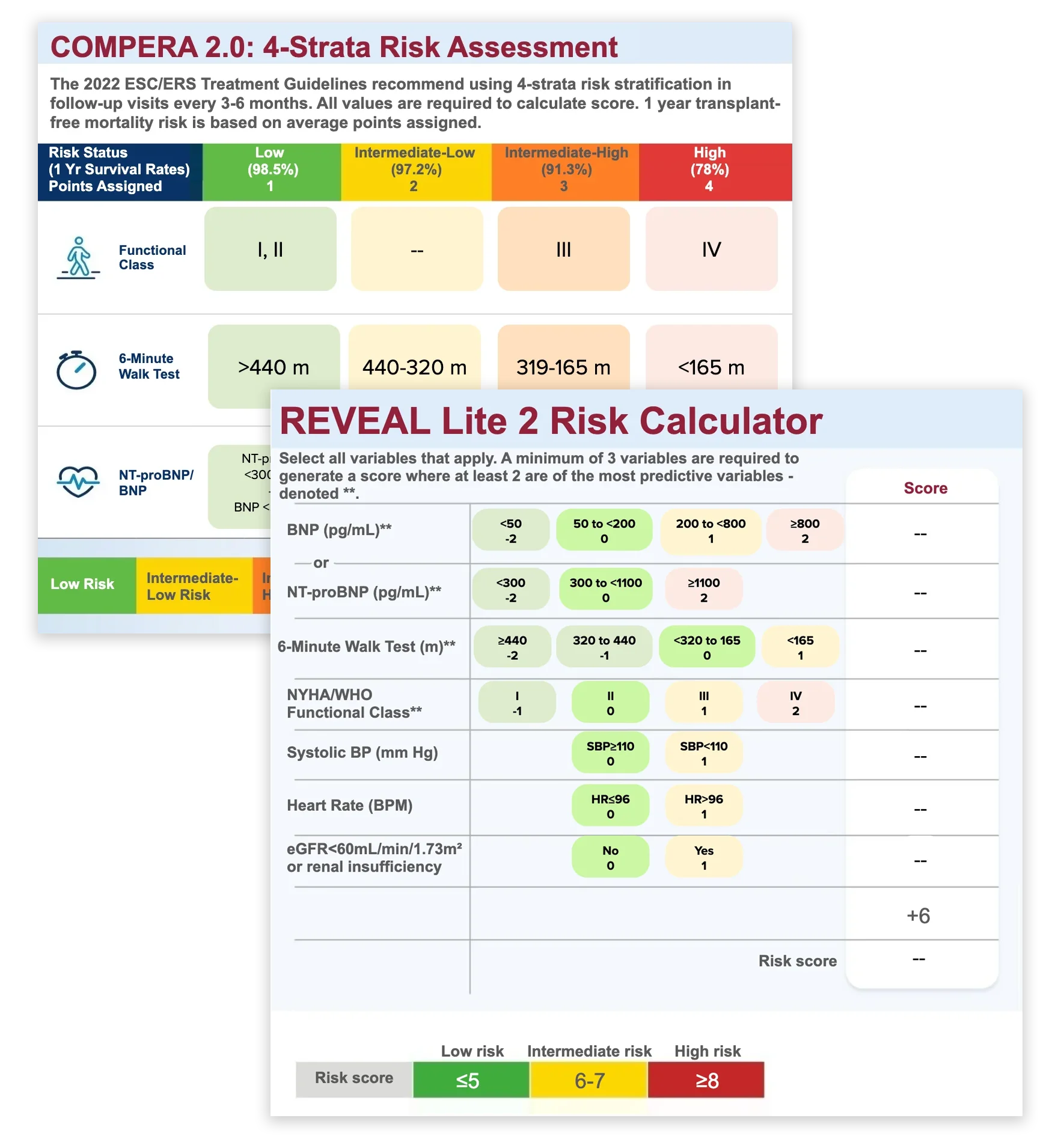
For patients not at low risk: Prompt adjustments to treatment plan are recommended1
Podcast icon

Therapy Escalation

Learn how to clinically apply risk status to determine when to escalate therapy and help improve patient prognosis.

Dr. Raymond Benza: Welcome to the PAH Initiative Podcast. This podcast is sponsored by, and the presenters are being compensated by, United Therapeutics. In this series of podcasts, we will talk about how PAH treatment guidelines and risk calculation drive treatment decisions in PAH, as well as our own experience in treating our patients with PAH. I'm Dr. Raymond Benza. And I have the pleasure today to be interchanging with a very good friend of mine, Dr. Vallerie McLaughlin.

Dr. Vallerie McLaughlin: Hi, Ray. Thank you for having me. It's great to be here.

Dr. Raymond Benza: In our last podcast, we discussed initial therapy choices in PAH and the importance of risk assessment in those decisions. In today's program, the third in our series of podcasts, we will discuss the need for regular risk assessments in PAH and escalating therapy, in order to help our patients achieve the low-risk status. So let's get started.

And Val, we know that our risk calculation needs to be performed to determine a patient's initial therapy regimen. After your patient begins their initial therapy, when are you performing risk calculations to assess whether they're meeting their treatment goals? And does this change based on the type of patient that you're looking at?

Dr. Vallerie McLaughlin: Yeah, Ray, that's a really important question. I think we have spent a lot of time over the years focusing on what's the right initial treatment, and obviously that's a very important question. But I think what's even the more important question is, where do we get with that initial treatment? What is that patient's risk? And do we need to do more?

I'll tell you, patients often ask me when they're diagnosed, "What's my prognosis? How long do I have to live?" And I tell you, I don't even want to answer that question at the time of diagnosis anymore because what's more important than what the risk status is at the time of diagnosis, is where they get in terms of their risk status on therapy.

So, that initial treatment choice is important, but it needs to be followed up. We need to reassess them on therapy to see if they're meeting the criteria for the low-risk status.

We tend to reassess our patients within about 3 months. We may call them over the phone before that 3-month visit, to make sure they're tolerating their therapy, and they're sticking with it, and that their side effects are well controlled.

But we'll generally bring pretty much all of our patients back to clinic within 3 months and reassess their risk, at the very least the assessment of Functional Class, the physical exam, the hall walk, biomarkers, often imaging as well. And we'll do an objective risk score, as we've talked about.

There are many from which to choose. REVEAL, which you've been so instrumentally involved in, Ray, the French, either invasive or noninvasive, or the ERS/ESC approach, but you need to do some objective assessment and determine whether or not the patient's at low-risk status. And if they're not at low-risk status, then you need to escalate therapy. And there are obviously many choices to do that.

Dr. Raymond Benza: Yeah, I think you brought up some very important points. The initial diagnosis and risk stratification really sets the tenor of that initial therapy, but it's really the follow-up assessment that really tells you what that trajectory is going to be and if that patient's moving in the right direction with that initial therapy.

So, I agree that second assessment is so important and having that done at least by the 3-month mark, after you're starting a therapy, I think is a really appropriate way to do it. So thanks for highlighting that.

So, when you see a patient and currently they're still at intermediate risk, how long would you wait before escalating their therapy?

Dr. Vallerie McLaughlin: Well, Ray, I think that's an important question. I would do it at that 3-month point. I don't think that waiting much longer is really going to benefit the patient. And, in fact, it may harm the patient.

I think the key there is intermediate risk. Intermediate risk, to me, is such a wide range. I hate to get too technical but, in my mind, there's low intermediate. There's high intermediate. I look at these patients in very different ways, and I know you do too. And the REVEAL risk score kind of delineates this a lot as well.

So, I definitely think at 3 months, if we are still in intermediate risk, we need to do something else. But then there's the opportunity to tease things out a little bit more, to determine how that should be done.

Dr. Raymond Benza: Yeah, I think that's a really important point, to really know where they fit in that intermediate range, because it is really a very big gray area for us. But I agree with you 100%. Don't leave people in intermediate risk. That's really important.

Why is it so important to be proactive in assessing patients and adding therapies when needed? And I know we talked a little bit that the last question, but given the progressive nature of the disease, are patients at risk for disease progression, even when symptoms are absent?

Dr. Vallerie McLaughlin: Well, Ray, PAH is a progressive disease. It's a disease with a high risk of mortality, even in patients who are on therapy. It is not uncommon that our patients sort of start compensating for themselves and adjust to a new way of life. In fact, there was a recent retrospective chart analysis that looked at 153 Functional Class 2 patients. And remember Functional Class 2 is just one of the parameters that we look at, but these are patients who are basically saying they're okay. But when you do objective assessments on them, a very high proportion of them are really technically at intermediate risk, or some even at high risk.

There's also that one paper that I love to cite. I think it's from the Amsterdam group, that does serial walks and MRIs and clinical assessments. And you'll look and see at their patients, the ones who deteriorate, and you will see changes in their MRI before they start telling you their symptoms are worsening.

So, I think we need to, again, rely on the multiparameter assessment, and we really need objective data to try to assess these patients' risk.

Dr. Raymond Benza: Yeah, that's a great point. If you think of this disease as a continuum, really, symptoms are really late manifestation of progression. So things could be going on, cellular changes, changes in hemodynamics and resistance, and even subtle decompensation of the right heart, that may not be felt at the time that it's happening, really trying to put together this multimodality approach, even in the asymptomatic patients, is really, really important to make sure they are truly at low risk, not only for mortality, but for morbidity too. Because remember, a lot of the scoring systems that we use are really focused on mortality, but you want to get into systems that also give you that risk of morbidity. And you want your patients to be at low risk, both for mortality and morbidity. So that's really important when you make the assessments, like you mentioned.

Dr. Vallerie McLaughlin: Yeah, I think, Ray, it's really important to mention that, if you wait too long, sometimes you never catch up. Dr. Raymond Benza: Exactly.

Dr. Vallerie McLaughlin: Right? We've seen this in clinical trials. We've seen this with placebo groups in clinical trials, that when therapy is delayed, they just don't improve as much as the patients who got active therapy early on. We've seen this in meta-analysis that patients, if you let their 6-minute walk deteriorate too much, they never catch up.

And, so, I think that is a really great argument for us to be more proactive about those treatment goals and about the timing of those assessments and getting to those goals.

Dr. Raymond Benza: Routine and regular monitoring is really the thought for the day, I guess, when we really think about it. When would you decide to actually prescribe a prostacyclin-class therapy?

Dr. Vallerie McLaughlin: Ray, I think that's a great question. And, again, you and I, we can admit, we're a little older. We grew up with parenteral prostacyclins. We're very comfortable with prostacyclins. And if they are not at low risk at their reassessment, it's time to consider a prostacyclin pathway agent.

Certainly, if a patient has high-risk symptoms and criteria, objective criteria, not meeting the French low-risk criteria, high REVEAL score, they're at high risk. And we often move to a parenteral prostacyclin therapy on them. Even some of the patients who are kind of at the high end of intermediate risk.

I think we have to keep our mind open to them and keep our patients' minds open to them, if they're in that higher-risk status.

However, if the patient is at intermediate risk, maybe they're a little better, but they're not meeting low-risk criteria, we have many other options, including different oral prostacyclin pathway agents, as well as inhaled.

Dr. Raymond Benza: Yeah, that's a really good point. I guess this is where really good communication between practitioners is really paramount. For those who you mentioned who have a little hesitation because they haven't had a lot of familiarity with this class, communication with an experienced center, to kind of help that practitioner through this with their patients is really, really key in the management schemata, so that patients really get the right drugs at the right time.

Dr. Vallerie McLaughlin: And this goes back to the excellent point you made about communication, Ray. We have to have open communication with our patients as well, and our nurses who tend to know the patients well, to determine their treatment goals, assess their risk, to think about how aggressive we need to get, and balance that with the side effects of the therapies.

Dr. Raymond Benza: Yeah, I think it's really important to message, as we both mentioned, that practitioners shouldn't be afraid to use prostacyclins in patients at a higher risk status. And if you don't know how to use it, just reach out for help, and there's always someone there.

When we use prostacyclins, what would you typically expect to see when you add this agent to a patient's regimen? What are the benefits that you might see from that?

Dr. Vallerie McLaughlin: Well, that's an excellent point, and it's something that needs to be emphasized with the patient, as we have goals with these agents. We've been talking in this series about risk, and it would be obvious to say we're trying to improve their risk profile. But the patient doesn't really care about the risk profile at that moment. They really care about how they feel.

So, there's data on prostacyclin-class therapies, about improving symptoms, improving Functional Class, improving hall walk, improving hemodynamics. These therapies improve a patient's ability to function, as they set their goal, whether that goal is to be able to take care of their kids or get back to some recreational exercise or be able to go up the stairs and do their job without shortness of breath.

They delay disease progression. And that's one of the reasons why we try to use them in patients who haven't achieved their risk.

These, of course, have to be balanced with the side effects. We know this class of agents have a number of side effects, including headache, diarrhea, jaw pain, nausea, sometimes musculoskeletal symptoms, flushing. And, so, we need to make sure the patients understand that, and that they understand the risks associated with the delivery system. Septicemia, bacteremia, if they're on IV. Cough in inhaled. Sometimes the GI side effects are worse on the orals.

So we need to make sure the patients understand that and understand that we will work with them and have lots of tricks up our sleeve to monitor those side effects and help obviate them.

But the whole reason that we're doing this is to improve their symptoms, improve their functional capacity, and improve their outcomes.

So you see what I just did there, Ray? I call that the benefits sandwich. You tell the patient why you're going to use that therapy, what to expect on the upside, our goals in terms of improving their symptoms and getting them back to what they want, have them set some goals.

Be careful. You have to tell patients about the side effects. We don't want to blindside them. So we go through the side effects and reassure them that we will be there to help them manage the side effects, but then put the other slice of bread on the sandwich. Remember, the whole reason we're doing this is so that they feel better, that they're able to do the things that they want.

Dr. Raymond Benza: Yeah. Val, what you just said really resonates with me. The goal for patients can be very different than the goal for physicians, and they really should align. A patient's conception of risk, they may not really be able to fully appreciate what that means for them while they're still having active symptoms.

So it's really important really to drive those symptoms to a state where a patient can really accept the importance of reducing their risk.

So, I really liked that sandwich approach, and I'm actually going to use that terminology the next time I see a new patient, is talk about the therapy sandwich. I like that.

Well, Val, thank you so much for joining me today for our discussion on timely treatment escalation. And I thank the audience for their listening in. And please join us next time, when we discuss the difficult conversations that we have with our patients regarding disease progression and management.

“Risk also helps fuel our approach to treatment, escalation of therapy based on risk. Critically important.”

Scott Visovatti, MD, Associate Professor of Medicine and Director, Pulmonary Hypertension Program, Ohio State University, Columbus, OH

Calculate risk with these resources

The PAH Initiative provides print and online resources to make multiparameter risk calculation even easier.
Choose the resource that works best for your practice.

6MWD=6-minute walk distance; CI=cardiac index; CMRI=cardiac magnetic resonance imaging​; COMPERA=Comparative, Prospective Registry of Newly Initiated Therapies for Pulmonary Hypertension; Echo=echocardiography; ERS=European Respiratory Society; ESC=European Society of Cardiology; FC=functional class; NT-proBNP=N-terminal pro–B-type natriuretic peptide; NYHA=New York Heart Association; RAP=right atrial pressure; REVEAL=Registry to EValuate Early And Long-term pulmonary arterial hypertension disease management; RV=right ventricle/right ventricular; SPAHR=Swedish Pulmonary Arterial Hypertension Registry; WHO=World Health Organization.
References: 1. Humbert M, et al. Eur Heart J. 2022;43(38):3618-3731. 2. Benza RL, et al. Chest. 2019;156(2):323-337. 3. Bouzina H, et al. ESC Heart Failure. 2021;8:680-690. 4. Kylhammar D, et al. Eur Heart J. 2018;39(47):4175-4181. 5. Benza RL, et al. Circulation. 2010;122(2):164-172. 6. Boucly A, et al. Eur Respir J. 2017;50(2):1700889. 7. Hoeper MM, et al. Eur Respir J. 2022;60:2102311. 8. Lai Y-C, et al. Circ Res. 2014;115(1):115-130. 9. Besinque GM, et al. Am J Manag Care. 2019;25(3 suppl):S47-S52. 10. Milks MW, et al. J Heart Lung Transplant. 2021;40(3):172‐182. 11. Dardi F, et al. Eur Respir J. 2024;64(4):2401323. 12. Chin KM, et al. Eur Respir J. 2024;64(4):2401325.
Various calculators on the PAH Risk Score Calculator app